
“Christian-run companies are multiplying in just about every corner of the globe, reshaping overseas mission work” says Andy Newman in a New York Times article1. Elsewhere, the book “Great Commission Companies: The Emerging Role of Business and Mission” by Steven Randal and Tom Steffen,2 was a result of a 5-year study of Christian entrepreneurs. It describes the ‘Great Commission Company’ (GCC) model as a Kingdom-business that: “is socially responsible, is an authentic business that creates wealth, is managed by professionals committed to serving Christ in the market place, deals ethically with all its stakeholders, and promotes the growth and multiplication of local churches. The profits are often used to support other local mission and ministry programs.” Hasty reviews of studies like these may lead to the sending of missionaries into business for impact, regardless of his or her talent or skill. Paul’s 1 Corinthians 9:22 passage seems to support this: “…I have become all things to all people so that by all possible means I might save some.” However, was Paul calling all believers to engage the world purely as a means of evangelism? Is there a place for calling and competence in Kingdom-business?
The creation commandment in Genesis 2:15 says: “Then the Lord God took the man and put him in the garden of Eden to tend and keep it.”
In Matthew 25:15, we see the Master distributed talents to his servants “…each according to his ability.” God called us first to bear His Image by carrying out His work as He designed us to for His glory. Meanwhile, the great commission in Matthew 28:19 still calls us to “Go therefore and make disciples of all the nations…”. This is an important balance.
If we ignore the Creation Commission, we risk setting up untrained missionaries for failure in businesses they have no acumen for. Instead, let us help them contribute fully within communities. Kingdom-workers must be fully productive contributors of society.
Likewise, if we ignore the Great Commission, we risk reserving Kingdom-work for pastors or overseas missionaries and not business owners with real access to the world. Let us engage businesses for the Kingdom. Business owners must also be fully Kingdom-workers.
It is time to redefine Kingdom business. Redefining Kingdom-business will take us returning to the heart of the King. The King knows His people and has gifted each one to get His Kingdom to the furthest reaches of the Earth. He expects us all to accomplish the creation commandment and live out our original design through hard work. Also, He entrusts all believers to reach out and make disciples in all nations even through business, and thus fulfil the great commission.
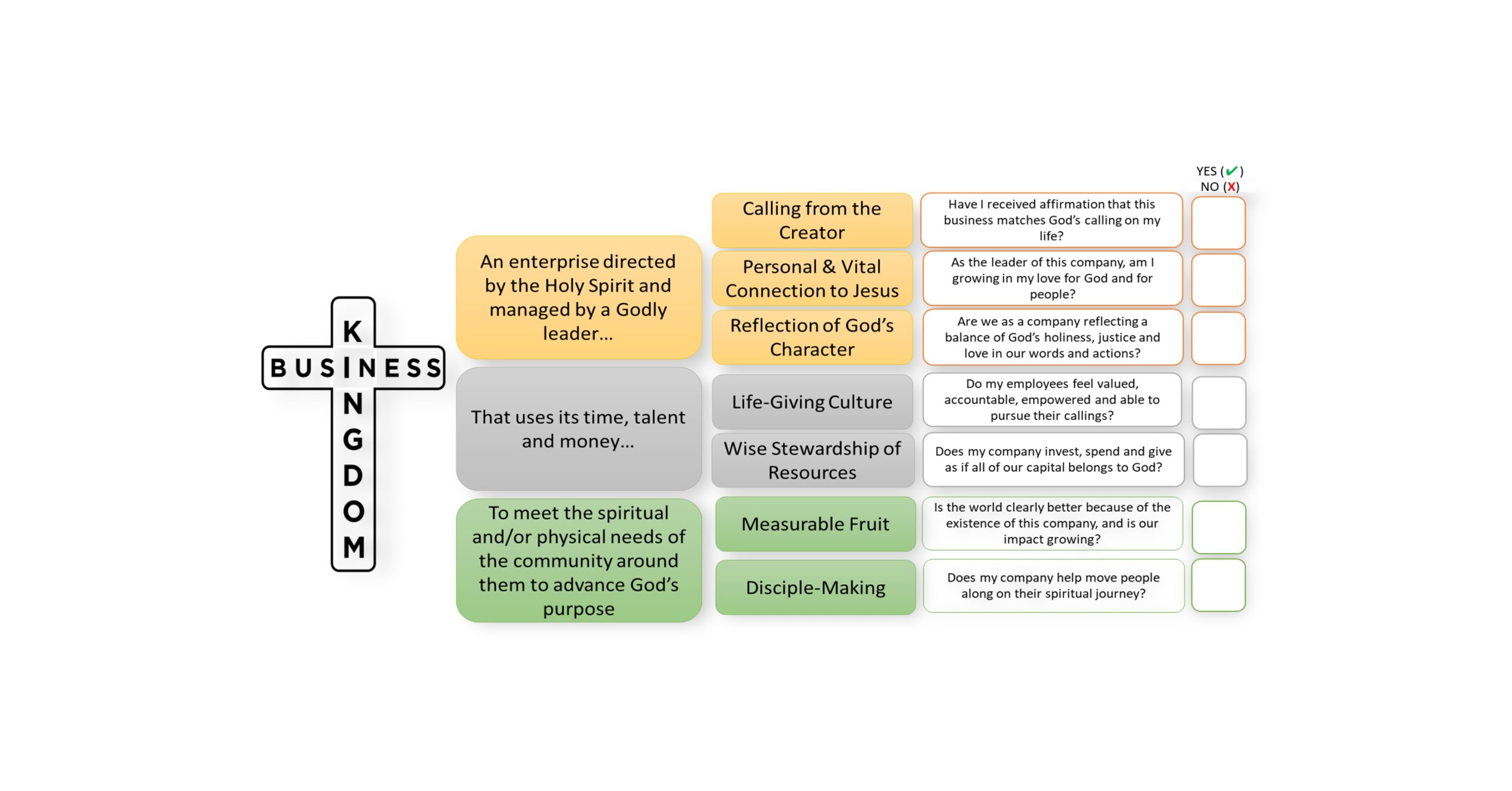
The figure below3 shows three parts to a Kingdom-Business: the enterprise, your involvement and the desired fruit. Is your Business a Kingdom-Business?
1. “Their Mission: Spreading the Word through business” by Andy Newman: https://www.nytimes.com/2005/11/14/giving/their-mission-spreading-the-word-through-business.html.
2. Great Commission Companies: The Emerging role of business in mission by Steve Rundle and Tom Steffen (pg. 41-42) and review by Stan Obermueller
3. Business As Mission- 7 Markers Kingdom Business by https://businessasmission.com/7-markers-kingdom-business/
See the following for an interesting take on how to make a difference in the Marketplace:
Integrity and Excellence Reel
Post a comment
Related Posts

August 1, 2024
BUILDING TOP ORGANIZATIONS
Following the global pandemic in 2019, organizations sought to operate almost fully online or find…