
CULTURAL TYPES
AND PARTNERING INTERNATIONALLY
by Boas Guehring
|
Stereotypes are often negative and wrong. But could they possibly stem from cultural truths? Cultures are beautiful and diverse. If you have ever noticed that different regions of the world respond to timelines, reporting, and communication differently from you, there may be a cultural reason why.
Richard Lewis’s model on Cultural Types highlights this phenomenon. His main premise is that cultural norms are either linear-active (like norms in Switzerland), multi-active (like cultural norms in Ethiopia) or reactive (like cultural norms in Japan). Most countries fall in-between Cultural Types, and the following picture shows where Lewis places them:
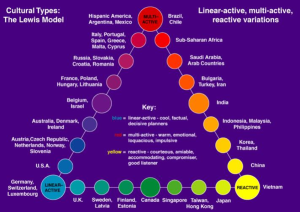
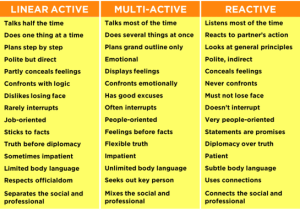
Alongside connecting countries and cultural types, Lewis describes and compares the three types. For example, to Lewis, linear-active types place truth before diplomacy, while multi-active types are flexible with the truth, and finally, reactive types would rather place diplomacy over truth. How does this play out in business today? The following is an example of how three cultures would possibly interact if a business started and failed between a linear-active individual (ie, a Swiss national), a multi-active (ie a Ethiopian) and a reactive one (ie a Japanese). If an update meeting were to take place in person, the Swiss may directly share the truth of the situation and why it failed, limit body language and rarely interrupt. The Ethiopian may share parts of the truth while constantly gauging the situation to know how much to withhold, use hand gestures and large body movements to self-express, interrupting if needed. According to Lewis, the Japanese may possibly not share the truth about failure, and rather present parts of the enterprise as a success. He would also be the most subtle in showing disappointment and while in conversation, would never interrupt. If the three were to plan a future project together, the Japanese would plan in accordance with the actions of the other two. The Swiss would plan step by step, while the Ethiopian would be quite content taking on several activities at the same time. The following table looks at some of these comparisons. Is the Lewis Model accurate in describing your cross-cultural business experience? If it is, how can you best prepare for your next multi-cultural experience using the model to maximize the benefits of our beautiful cultural differences?
Post a comment
Related Posts

September 17, 2024
CONTRACT vs. COVENANT
BIBLICAL LESSONS AND WARNINGS FOR GODLY BUSINESS PARTNERSHIPS By Hermann Guehring I believe that Godly…